Marley Kong, I Have Always Yearned to Reach Gold Mountain, 2026
Acrylic and archival inkjet print on bamboo paper with laser-engraved text on acrylic glazing
16 x 20 in. (40.6 x 50.8 cm), Edition: Unique
© Marley Kong. Photo: Tim Chang
一心只望來金山
誰知金山窮艱難
困人監房眼淚流成行
妻子在家望信番
誰知三冬二秋轉回唐
民國八年口月
I have always yearned to reach Gold Mountain,¹
Unexpectedly, I found only poverty and hardship.
I was detained in a cell, and tears rolled down my cheeks.
My wife at home is longing for my letter,
Who can foretell when I will be able to return home?
Eight year of the Republic (1919)²
¹ Gold Mountain (Gum Saan) is a historic name used by Cantonese-speaking Chinese immigrants in Canada, starting in mid-19th century during the gold rush, in reference to British Columbia, particularly the lower Fraser Valley.
² The poem was found carved on a wall in the Immigration Building that once stood on the corner of Ontario and Dallas Streets in Victoria, B.C., which was used as a detention centre for immigrants entering Canada from 1908 to 1958. Trans. Charles Egan et al., in Island: Poetry and History of Chinese Immigrants on Angel Island 1910 - 1940, 2nd ed. (Seattle: University of Washington Press, 2014).
Exhibited: May 29 - June 26, 2026, Community Exhibition, Place des Arts, Coquitlam, BC, Canada
/ July 2 - 19, 2026, SPECTRUM, Silk Purse Arts Centre, West Vancouver, BC, Canada
/ September 16 - October 11, 2026, Words + Pictures, Silk Purse Arts Centre, West Vancouver, BC, Canada
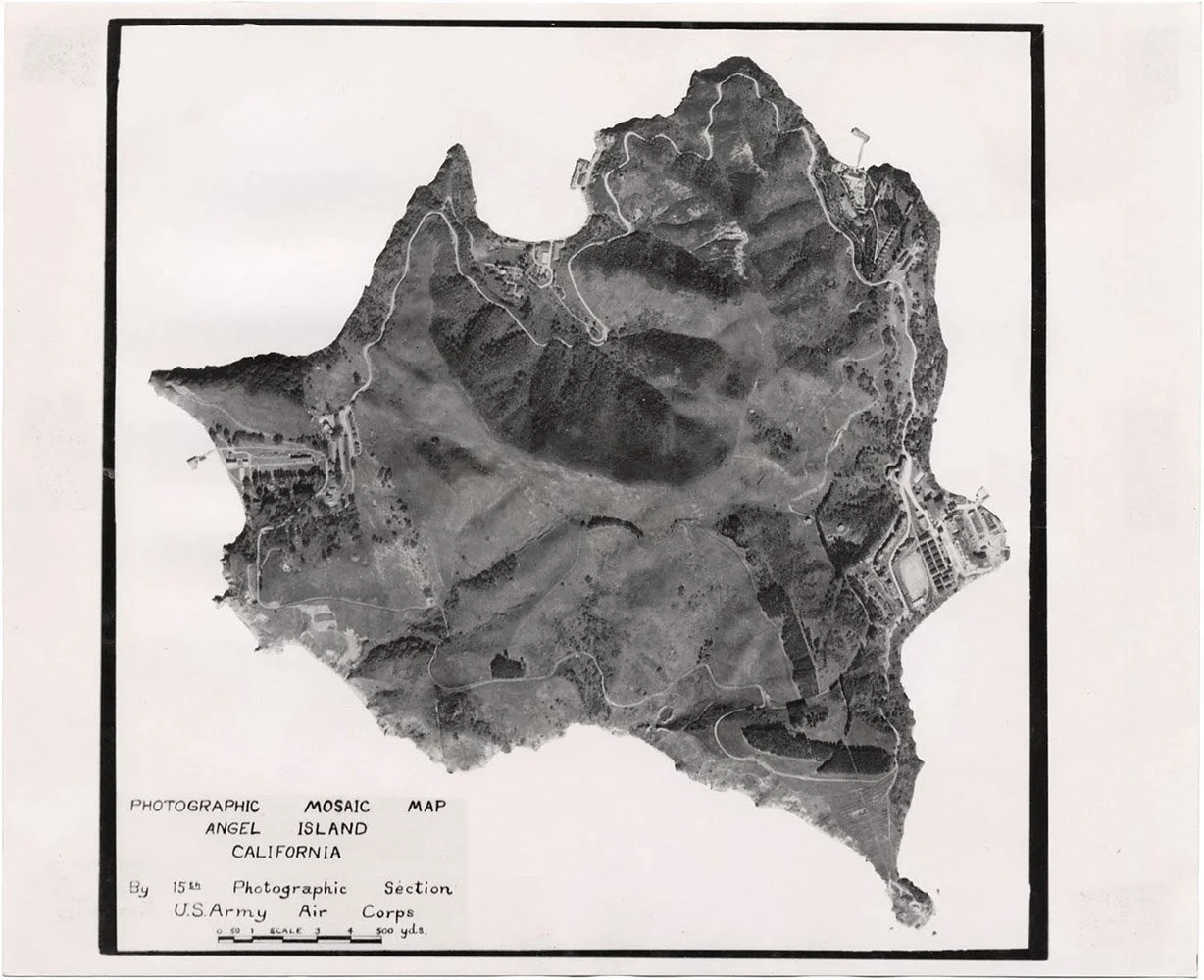
Photographic Mosaic Map of Angel Island by U.S. Army Air Corps, 15th Photographic Section, C. 1930S. Courtesy of the National Archives and Records Administration (NARA).
埃崙詩集 Island Series
In the early 20th Century, Chinese immigrants entering Canada and the U.S. were regularly detained in immigration buildings, where hundreds of poems recording their experience in detention have been found carved on walls, and have since been documented, translated, and published.
In Marley Kong’s research-driven Island Series, a curated selection of the poems are executed in calligraphy on top of digitally-altered historical photographs of the buildings where they were found. I have Always Yearned to Rach Gold Mountain and The Gentlemen Is Content in Poverty depict the Immigration Building that once stood in Victoria, B.C., Though Imprisonment Is Bitter shows an aerial view of Ellis Island in New York, and When A Newcomer Arrives in America portrays the Immigration Station on Angel Island (next to the infamous Alcatraz Island) in San Francisco Bay, California.
Further expanding the 2026 Series, Counting on My Fingers and The Young Children (The Angel of Angel Island) feature historical photographs of detainees on Angel Island. Highlighted in fluorescent colours against original black and white backgrounds, a group of boys are undergoing medical examinations in Counting, while The Young Children depicts a group of women and infants accompanied by Deaconess Katharine Maurer (1881–1962), a dedicated social worker who provided aid and advocacy to the detainees and thus known as “The Angel of Angel Island.”
Kong’s rendering of the poems in calligraphy evokes a sense of historical authenticity; however, this is juxtaposed by the eerie fluorescent colours and the superimposition of the text on the photographs, which transcends the image to the present day. The hand-written calligraphy is further juxtaposed by the laser-engraved text on the acrylic of the frame, which visualizes a barrier and disconnect between the translation and original material. The works not only highlight the past anger, frustration, hopes, and despair of the detainees, but also reflect poem’s relevance to the present.
Marley Kong, When a Newcomer Arrives in America, 2026
Acrylic and archival inkjet print on bamboo paper with laser-engraved text on acrylic glazing
16 x 20 in. (40.6 x 50.8 cm), Edition: Unique
© Marley Kong. Photo: Tim Chang
新客到美洲
必逮入木樓
嚴如大犯樣
在此經一秋
When a newcomer arrives in America,
He will surely be arrested and put in the wooden building,
Like a major criminal.
I have already been here one autumn.³
³ This poem was found carved on a wall in the Immigration Station on Angel Island in San Francisco Bay, California, which was used as a detention centre for immigrants entering the U.S. from 1910 to 1940. Trans. Charles Egan et al., in Island: Poetry and History of Chinese Immigrants on Angel Island 1910 - 1940, 2nd ed. (Seattle: University of Washington Press, 2014).
Exhibited: May 29 - June 26, 2026, Community Exhibition, Place des Arts, Coquitlam, BC, Canada
/ September 16 - October 11, 2026, Words + Pictures, Silk Purse Arts Centre, West Vancouver, BC, Canada
Marley Kong, Though Imprisonment Is Bitter, 2026
Acrylic and archival inkjet print on bamboo paper with laser-engraved text on acrylic glazing
18 × 24 in. (45.7 × 61 cm), Edition: Unique
© Marley Kong. Photo: Tim Chang
長監苦困壽命長
去船恐有身受傷
勸君莫怕移民例
定有安然放我歸
Though imprisonment is bitter, my life will be long;
When I landed from the ship, I feared bodily harm.
I urge you: don’t be afraid of immigration laws—
It’s certain we’ll be freed to go home in peace.⁴
⁴ This poem was found carved on a wall in the Main Building on Ellis Island in New York, where twelve million immigrants were processed through between 1892 to 1954, among which were a few thousand Chinese. Trans. Charles Egan et al., in Island: Poetry and History of Chinese Immigrants on Angel Island 1910 - 1940, 2nd ed. (Seattle: University of Washington Press, 2014).
Exhibited: September 16 - October 11, 2026, Words + Pictures, Silk Purse Arts Centre, West Vancouver, BC, Canada
Marley Kong,The Gentleman is Content in Poverty, 2026
Acrylic and archival inkjet print on bamboo paper with laser-engraved text on acrylic glazing
18 × 24 in. (45.7 × 61 cm), Edition: Unique
© Marley Kong. Photo: Tim Chang
“The Gentleman is content in poverty”⁵ — but he need not be poor;
Why then, has it been my fate to be imprisoned in a cage?
Though China is vast, for me there wasn’t room to stick an awl,⁶
So I rode the waves to the ends of the earth and now cry bloody tears.
En Route to Canada in 1921, Imprisoned in the Vancouver Immigration Jail⁷
君子固窮未必窮
何期遭際困囚籠
中華偌大無容錐
浪走天涯血淚紅
民十[年]赴加困于雲埠移民監
⁵ Quoted from Passage 2, Chapter 15 of the Analects of Confucius: “The Gentleman is content in poverty, while the small man is swept away by it.”
⁶ Referenced a line from the 4th to 10th centuries BCE philosophical text The Zhuangzi. Not having a room to even stick an awl is a metaphor for having no foothold in society and extreme poverty.
⁷ The poem was found carved on a wall in the Immigration Building at the corner of Ontario and Dallas Streets in Victoria, B.C., which was used as a detention centre for immigrants entering Canada from 1908 to to 1958. Trans. Charles Egan et al., in Island: Poetry and History of Chinese Immigrants on Angel Island 1910 - 1940, 2nd ed. (Seattle: University of Washington Press, 2014).
Exhibited: September 27 - November 22, 2026, Juried Art Exhibit, Coquitlam Public Library (Poirier Branch), Coquitlam, BC, Canada
Marley Kong, Counting on My Fingers, 2026
Acrylic and archival inkjet print on bamboo paper with laser-engraved text on acrylic glazing
24 × 36 in. (61 × 91.4 cm), Edition: Unique
© Marley Kong. Photo: Tim Chang
屈指經數月
尚在此路頭
至今未曾審
懸望心悠悠
Counting on my fingers, several months have elapsed.
Still I am at the beginning of the road.
I have yet to be interrogated.
My heart is nervous with anticipation.⁸
⁸ This poem was found carved on a wall in the Immigration Station on Angel Island in San Francisco Bay, California, which was used as a detention centre for immigrants entering the U.S. from 1910 to 1940. Trans. Charles Egan et al., in Island: Poetry and History of Chinese Immigrants on Angel Island 1910 - 1940, 2nd ed. (Seattle: University of Washington Press, 2014)
Exhibited: September 16 - October 11, 2026, Words + Pictures, Silk Purse Arts Centre, West Vancouver, BC, Canada
Marley Kong, The Young Children (The Angel of Angel Island), 2026
Acrylic and archival inkjet print on bamboo paper with laser-engraved text on acrylic glazing
24 × 36 in. (61 × 91.4 cm), Edition: Unique
© Marley Kong. Photo: Tim Chang
少年子弟未知愁
來到金山困木樓
不悟眼前悲苦境
還要終日戲如牛
The young children do not yet know worry.
Arriving at Gold Mountain, they were imprisoned in the wooden building.
Not understanding the sad and miserable situation before their eyes,
They still want to play all day like calves.⁹
⁹ This poem was found carved on a wall in the Immigration Station on Angel Island in San Francisco Bay, California, which was used as a detention centre for immigrants entering the U.S. from 1910 to 1940. Trans. Charles Egan et al., in Island: Poetry and History of Chinese Immigrants on Angel Island 1910 - 1940, 2nd ed. (Seattle: University of Washington Press, 2014)
Exhibited: October 12 - November 8, 2026, Making Kin at the End of the World, Access Gallery, Vancouver, BC, Canada